
Meet the beekeeper
Emily Huxter
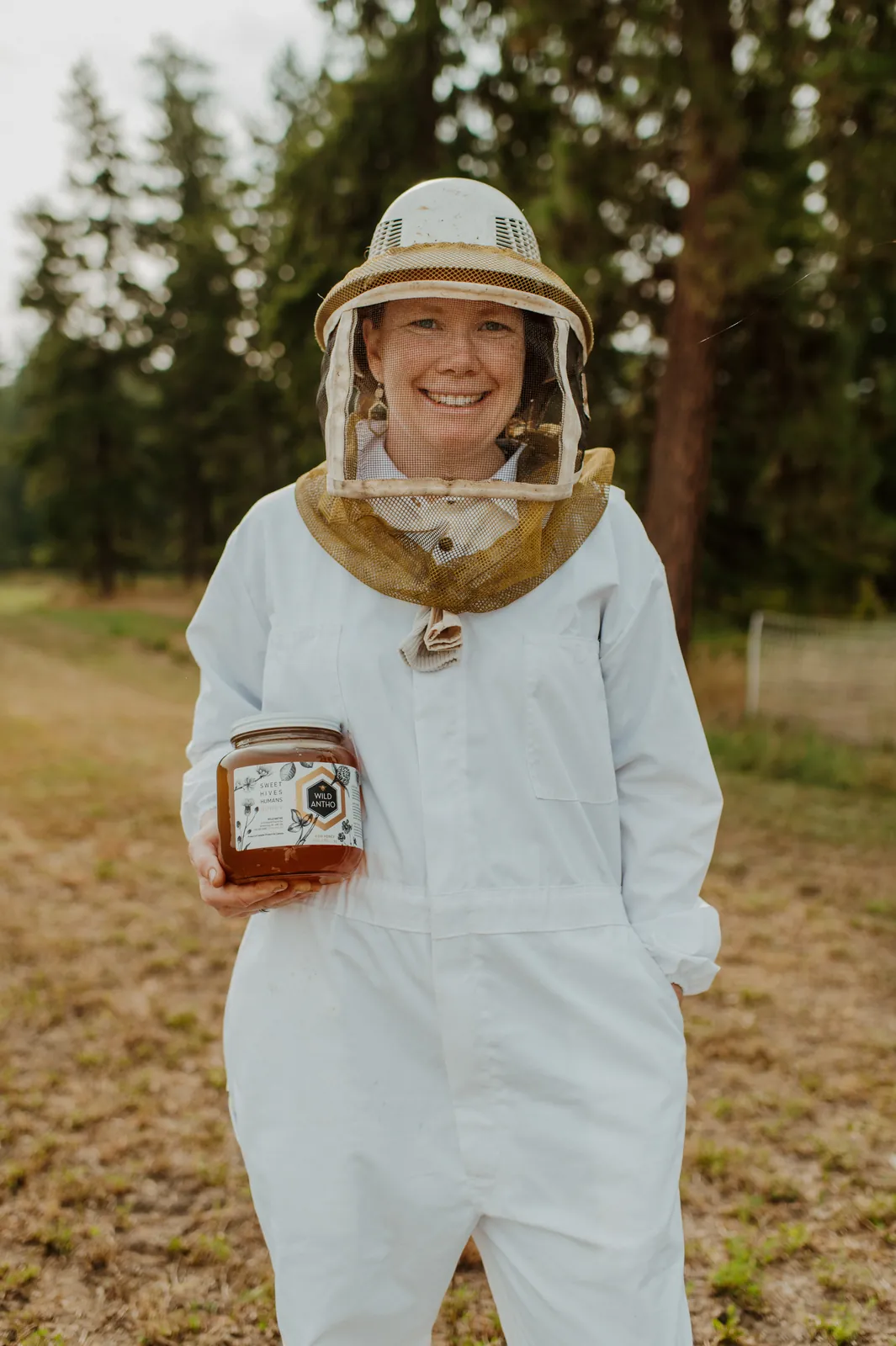
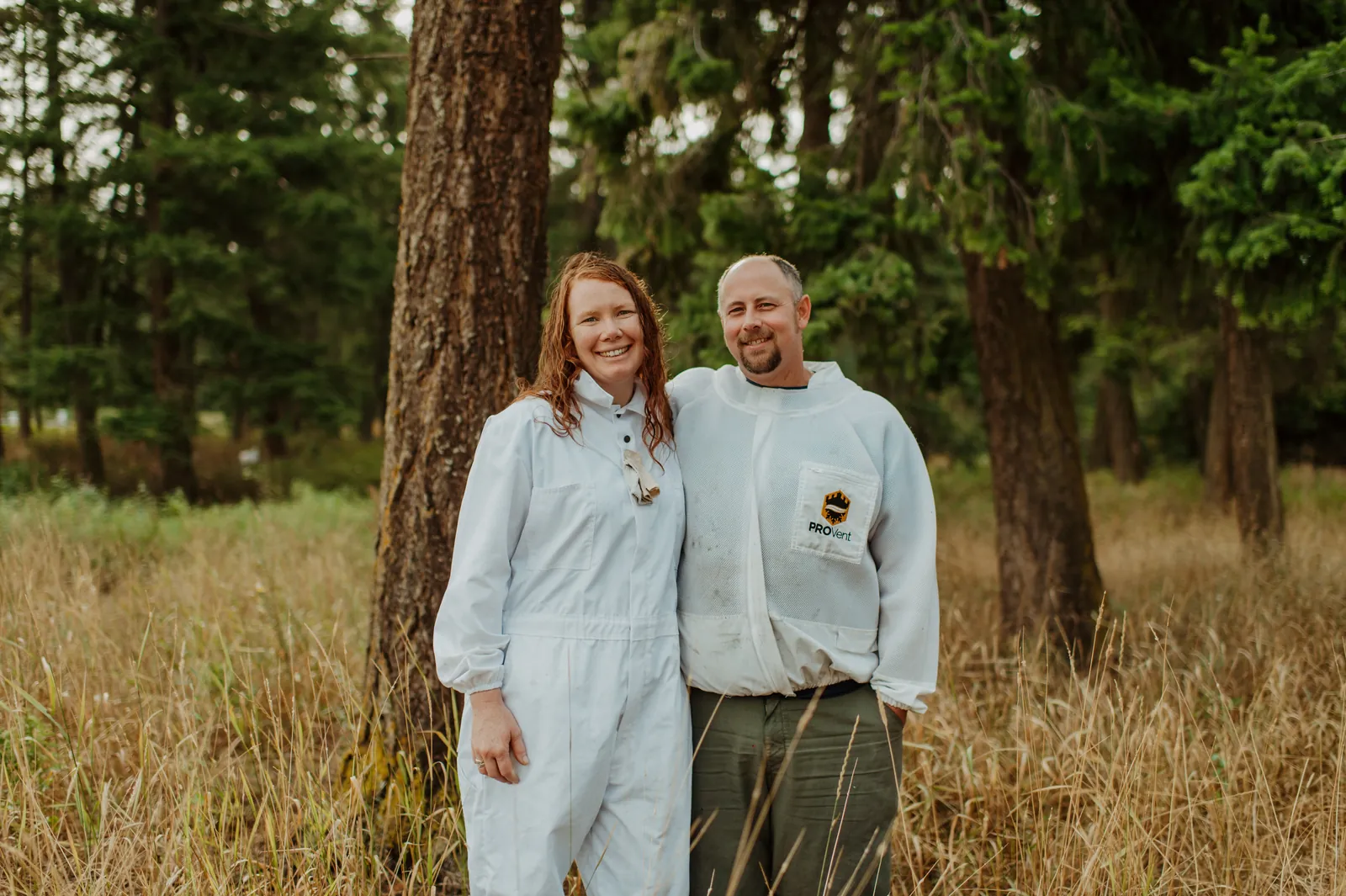
Beekeeper of at least the fourth generation. Queen breeder. Hydrologist for 14 years before that. Emily runs Wild Antho with Shayne Doerksen on a farm near Armstrong, BC.
Born into bees
A first sting at two weeks old
Emily was born in 1980, the year her parents started Terry's Honey Farm in Grand Forks, BC. If the family tales are true, she was stung for the first time at two weeks old. She spent her childhood travelling from bee yard to bee yard.
The work started early. In winter she pressed out pollen patties. In summer she ran the smoker. Some of it she liked. Some of it she did not. She vowed her whole childhood that she would never keep bees. By high school her summers were split between swimming and bees.
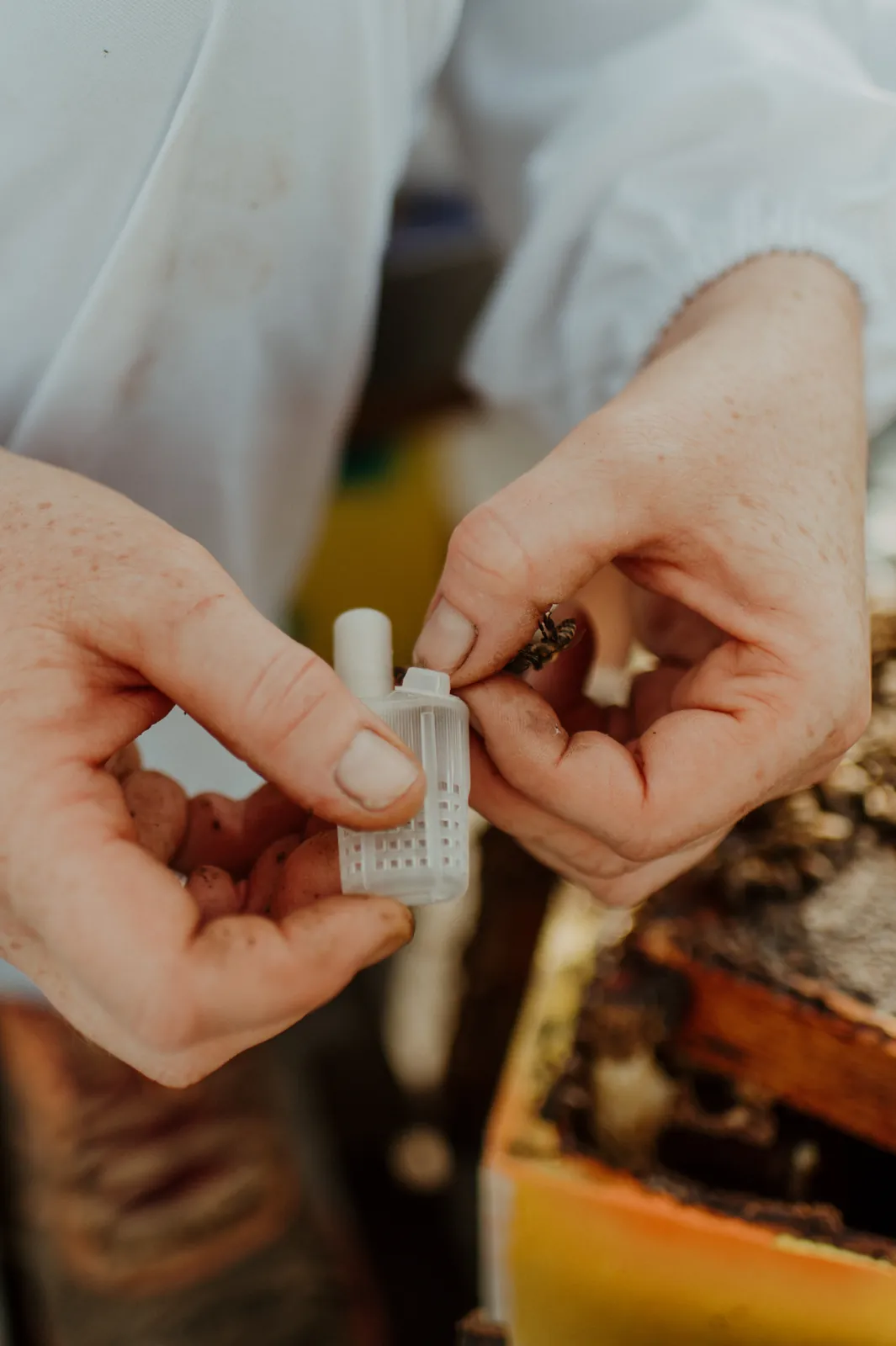
Most of those hours went to her mother, Liz Huxter, who was breeding queens. Emily caught queens, fed the four-way mating nucleus colonies, and ran grafts. A graft is the first step in raising a queen. A larva less than a day old is lifted from its cell and set into a queen cup, so the colony raises it as a queen instead of a worker. Emily learned it as a teenager and did it every summer until she finished university.
At least four generations
Milk and honey, then just honey
Emily's father Terry grew up on the family dairy farm in England, a farm that had been in the family for generations and kept hives the whole time, alongside the herd. Milk and honey, he called it. His father kept those bees and sold the honey at car boot sales and through the Women's Institute. His father kept them before him, and his before that, as far back as anyone knows. Nobody in the family can name the first Huxter with a hive.
Her parents, Terry and Liz Huxter, met at university in Scotland. Terry is a botanist, and the job that brought the pair to Canada was teaching botany at a university in Alberta. Liz was born in the United States and worked as a geologist, so Canada was neutral ground as well as a post. They kept bees on the side until 1980, when they quit both careers, bought a bee farm in Grand Forks, and started Terry's Honey Farm.
Liz went on to become one of the most respected beekeepers and queen breeders in Canada. Emily's brother Doug runs Terry's Honey Farm today. Emily is the fourth generation that anyone can count. The line runs further back than the records do.
Hydrology
Fourteen years measuring rivers
Emily trained as a hydrologist and finished a master's degree. She spent 14 years with Environment Canada in the Hydrology department, measuring and modelling stream flows. In 2013 she co-authored a paper on intermittent and perennial streams in the Okanagan for the Canadian Water Resources Journal.
The bees did not stop. Emily and Shayne kept hives in their backyard and in neighbours' backyards, raised their own queens, and sold a few nucleus colonies on the side.
The habit of measuring came with her. Wild Antho screens its breeder colonies for hygienic behaviour and varroa sensitive hygiene, and sends queens for queen quality testing at the National Bee Diagnostic Centre every year. See how we test what we breed.
Wild Antho
A year at her parents' farm first
In 2018 Emily and Shayne bought a farm near Armstrong. Before they committed to it, Emily spent a year working at her parents' farm in Grand Forks. The first Wild Antho season ran in 2019.
The farm is built around nucleus colonies and queens, with honey as a sideline. It winters about 1,500 colonies and runs close to 1,000 more small colonies through the summer to raise queens. Queens ship by Canada Post and courier across Canada. Most nucleus colonies go home with beekeepers from the prairies and the Peace River region.
Her aim is a good local queen in early April, so Canadian beekeepers do not have to wait on imports. Most of the work of the next few years is overwintering queens to make that date.
The stock
The same line her mother started in 1980
Wild Antho breeds a true BC stock. It began as Kettle Valley Queens stock, the line Liz Huxter has selected in Grand Forks for more than 40 years, and Emily still brings breeder queens from her mother's yards. The bees run dark, hygienic, and winter well.
Emily breeds from her own stock and does not buy in queens. When student researchers at UBC Okanagan asked in 2023 whether she would use pre-treated queens from outside, the answer was no. The line is the point.
Weather
The heat dome, and the up and down
During the 2021 heat dome, drones died in the air over the farm. Emily told Castanet in 2024 that they "literally rained out of the sky." With the drones gone, queens could not mate, and breeding stalled.
Since then the hives stay insulated all year, not only for winter. Bees burn energy every time they cluster and break cluster, and a fast swing can kill a colony that does not get back into cluster in time. In Emily's words, "it's not so much the cold or the hot that's the problem, it's the up and down."
After the heat dome, Emily called UBC researcher Dr. Alison McAfee, who studies how heat damages queens and drones. Together they ran a trial on the farm. Polystyrene lids cut the daily high inside the hive by 3.8 °C. A sugar syrup drip cut it by 1.1 °C. Every Wild Antho hive now wears a two inch polystyrene lid. Read the story in the Times Colonist.
Sharing what she knows
Straight answers about bees and money
Emily was the first guest on the Farming in British Columbia podcast, talking through the economics of honey on the prairies and in the Okanagan, and what a honey label does and does not tell you. The queen breeding half of that conversation became its own episode, The Queen Bee (Breeder) of Spallumcheen.
Emily is a trustee of the Boone Hodgson Wilkinson Trust Foundation, which funds bee research and scholarships in B.C. She is also a member of the Regional Agricultural Advisory Committee of the Regional District of North Okanagan, which looks at land use around farming.
She has advised student researchers at UBC Okanagan on how commercial beekeepers decide, and she is a member of the BC Bee Breeders' Association. Jeff Lee of Honey Bee Zen Apiaries in Creston, who rebuilt his hives on Huxter queens after a hard winter, calls her Liz's "equally gifted daughter."
Wild Antho is provincially inspected by the BC Ministry of Agriculture. Inspection reports go to every buyer of live bees.