
Nucleus colonies
Honey bee nucleus colonies
Order bees online and collect them at our farm in Armstrong, BC. Each nucleus colony holds three frames of brood, a frame of honey, and a queen we reared ourselves.
Available now
The 2027 season is nearly sold out, in August 2026. Ask to go on the list and we will tell you where you stand.
Checked 13 September 2026
How to order
Order online, pick up at the farm in spring
Tell us how many nucleus colonies you want and which size, using the form on this page. We confirm each order with you by email or phone. Nucleus colonies are ready from mid April, and you collect them at the farm. We do not ship nucleus colonies. If you want to buy bees online and have them delivered, queens are the ones we post.
A nucleus colony, which beekeepers often shorten to nuc, is a small working hive: bees, brood, honey, and a laying queen, ready to move into your own equipment and grow. Ours are provincially inspected, and the inspection report comes with the bees.
First nucleus colony? Read how to buy a nucleus colony in BC, including what to bring on pickup day.
What you get
Three frames of brood and a frame of honey
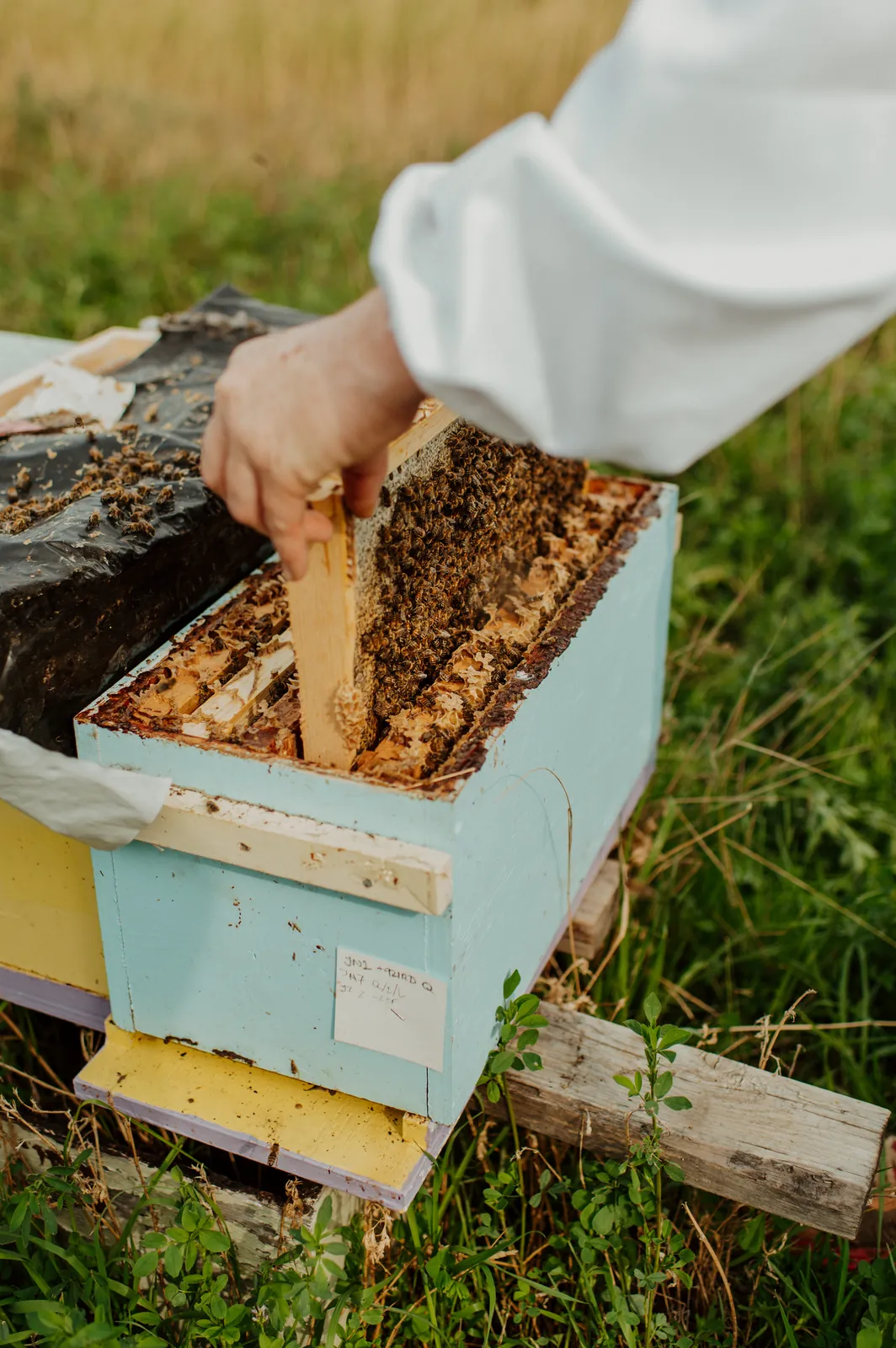
Each nucleus colony has 3 frames of brood with bees, plus a frame of honey and bees. We choose the queen for each one. We build every colony to expand fast once it is in your equipment.
4 frame nucleus colony, April $450
Our cardboard box, 4 frames of bees (3 brood, 1 honey). Ready from mid April, headed by an overwintered queen.
4 frame nucleus colony, mid May $325
The same 4 frame nucleus colony in our cardboard box, ready mid May.
5 frame nucleus colony $375
Your box, 5 frames of bees (3 brood, 1 honey, 1 empty). For larger orders. Ready in May. The early nucleus colonies have an overwintered queen. Orders under 10. For 10 or more, call for pricing.
Sizes
Nucleus colonies in 4 and 5 frame
4 frame nucleus colonies come in our cardboard box with 4 frames of bees: 3 of brood and 1 of honey. They are ready from mid April. The April nucleus colonies have an overwintered queen.
5 frame nucleus colonies are for larger orders. They go into your own box and hold 5 frames of bees: 3 of brood, 1 of honey, and 1 empty for the queen to lay into. The early nucleus colonies have an overwintered queen.
5 frame nucleus colonies are ready in May. On 10 or more, call us for pricing. See the season below.
Draft figures, set from market rates. Not confirmed.
Order terms
- Deposit to reserve
- $150 per nucleus colony
- Order by
- February 28
- Pickup
- Mid April to May, at the farm
Early and late
Why the April colonies cost more
Every nucleus colony we sell is raised with one of our own queens. The earliest ones are headed by an overwintered queen, and that changes what you are buying. In about three weeks, an April colony can grow strong enough to split in two. A buyer who takes one in April is close to buying two colonies.
The price slides down as spring goes on. A nucleus colony sold in late May is often the third one we have made from a single overwintered colony.
We overwinter about 1,500 colonies. Through the summer we run close to 1,000 more small colonies to raise queens, and we combine those down in the fall, because colonies that small will not make it through a winter here.
Explained
A small colony, already working
A nucleus colony starts as a piece of a strong hive. A strong colony wants to swarm in spring. We skim frames of brood and honey off it first, with the young nurse bees still on them. In effect we make the swarm ourselves. Then we give those frames a queen from our breeding program. She settles in and starts to lay. By the time you collect it, the nucleus colony has brood at every stage, from egg to capped, and a queen you can find on the comb.
The box is a narrow version of a standard hive. It takes the same frames as a 10 frame Langstroth box, just fewer of them. A small space lets a young colony hold its heat and humidity, which is what brood needs. That is the whole point of a nucleus box.
A nucleus colony is not a package. A package is loose bees shaken into a screened box with a caged queen, and no comb or brood at all. A nucleus colony arrives with drawn comb, food, and a laying queen the bees already accept, so it builds up weeks faster in a BC spring. We sell nucleus colonies. We do not sell packages.
When you get it home, move the frames into your own hive body within a day or two and keep them in the same order. Feed syrup until the bees draw fresh comb and the nectar comes on. Keep the entrance small for the first weeks, because a small colony is easy for a stronger hive to rob. Started in May, a nucleus colony grows into a full colony by late summer. It is not built to winter as a nucleus colony.
We use nucleus colonies in our own yard too. Our queens mate from small mating nucleus colonies, each holding one young queen and a handful of workers, before they are caged, sold, or given a nucleus colony of their own to head.
Getting them home
Pickup at the farm, always
We do not ship nucleus colonies, at any quantity. Once the bees leave the farm they are your responsibility, and a colony in transit is not a risk we will take on your behalf. Every nucleus colony is collected from the farm at Armstrong.
Buyers arrange their own transport and people have driven from as far east as Manitoba for them. Larger orders usually organise their own trucking. Queens are the other way around: those we post anywhere in Canada.
When
Nucleus colonies go out from mid April through May
The season runs from mid April to about the first of June. There are sometimes nucleus colonies in June, but treat those as a bonus rather than the plan.
Ask early. Repeat buyers carry their standing orders over from one year to the next, new requests start coming in around October, and we are usually spoken for well before spring. If we are full we will tell you straight away and put you on the list for the year after.
Order
Tell us what you need
Tell us how many you are after and when you would like them, and we will come back to you.
Nothing on this page takes a payment. No nucleus colony is reserved until we have confirmed it with you.
The queen inside
A true B.C. stock, 40 years in the making
We breed every queen from our own stock, a true B.C. line developed over the past 40 years. Every nucleus colony is headed by one of those queens.
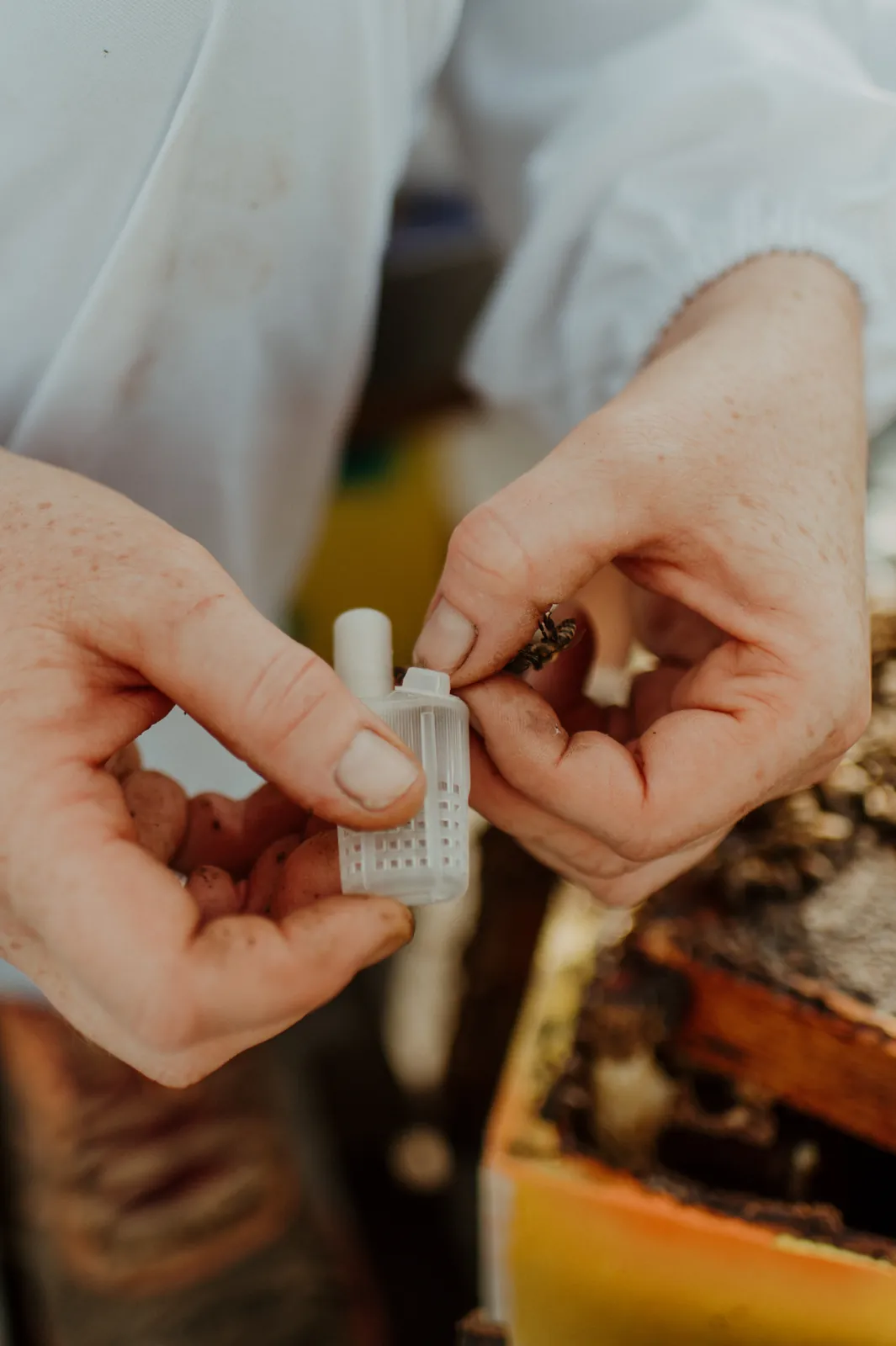
Our bees are provincially inspected by the BC Ministry of Agriculture. Inspection reports go to every buyer of live bees.
When to order
The ordering year
Nucleus colonies are collected at the farm from mid April through May. Everything before that is booking, and most of a season is spoken for long before the bees are ready.
- October to January
- Orders open for the coming spring, and the waiting list forms. Standing orders from repeat buyers carry over first. This is the quiet, sensible time to book.
- February to April
- The busiest months. Most of the nucleus colonies and a good share of the queens are spoken for in this window, so a February order gets what a May order cannot.
- Mid April to May
- Nucleus colonies are collected at the farm. The first 4 frame nucleus colonies are ready from mid April, headed by an overwintered queen. Queens start shipping in the first week of May and go out weekly from then on.
- June
- The last nucleus colonies go out, and a June nucleus colony is a bonus rather than the plan. Queens keep shipping every week.
- July to August 10
- Queens only. Late July into early August is the last good window to requeen before a colony starts raising its winter bees. Shipping stops around the tenth.
- August to September
- Honey. The crop comes off, three varieties are usually on hand, and the farm shop is the place to get it.
Larger orders
Buying nucleus colonies by the load
Commercial outfits, clubs buying together, and research programs have their own page, with how a large order gets filled and what to send us.
Questions
Common questions
How much is a nucleus colony?
A Wild Antho 4 frame nucleus colony is $450 in April, with an overwintered queen, and $325 in mid May. A 5 frame nucleus colony is $375 on orders under 10. All are collected at the farm in Armstrong, B.C.
When are nucleus colonies ready?
Wild Antho 4 frame nucleus colonies are ready from mid April, and 5 frame nucleus colonies in May. The season runs to about the first of June, and a June nucleus colony is a bonus rather than the plan.
Do you ship nucleus colonies?
No. Wild Antho nucleus colonies are pickup only, at every quantity, and are never shipped or delivered. Buyers arrange their own transport from the farm at Armstrong, and have driven them as far as Manitoba.
What is the difference between a 4 frame and a 5 frame nucleus colony?
A Wild Antho 4 frame nucleus colony comes in the farm's own cardboard box, with three frames of brood and a frame of honey. A 5 frame nucleus colony goes into a box you bring, with three frames of brood, a frame of honey, and an empty frame to build into.
Do you sell to hobby beekeepers?
Yes. Most Wild Antho nucleus colonies go to people taking one or two, usually backyard and hobby beekeepers replacing a colony they lost over winter.
Do you have nucleus colonies available right now?
The availability line at the top of the Wild Antho nucleus colonies page is kept current and dated. Nucleus colonies are collected from mid April through May, and most of a season is spoken for months ahead, so the honest answer in spring is usually the waiting list for the following year.
When should I order for next season?
Order as early as you can. Wild Antho nucleus colonies are largely spoken for months ahead: standing orders from repeat buyers carry over each year, new requests start arriving in October, and a waiting list follows.
Will these bees handle a colder site than Armstrong?
Wild Antho queens and nucleus colonies are raised and overwintered in the British Columbia interior, so the stock has already proved it can come through a Canadian winter. Buyers run them from the Kootenays to the Cariboo and east to Manitoba.