
Hives and queens
Queen bees
We breed every queen we sell, here, from our own stock. They are raised and overwintered in the B.C. interior, and they ship across Canada from early May to August.
Available now
Taking orders for the 2027 season. Queens ship weekly from early May to about August 10, and can be collected at the farm.
Checked 13 September 2026
Our stock
A true B.C. stock, 40 years in the making
We breed all of our own queens, from all of our own stock. It is a true B.C. stock, developed over the past 40 years. We took over the Kettle Valley Queens line that Liz Huxter bred for about 35 years before us, and we still bring in breeding stock from her. Our queens tend to produce dark bees.
A breeder queen has to earn her place. She must be at least two years old, which means two winters. Her colony makes an average or better honey crop every year. Her brood pattern is solid year-round, and her pollen stores are good. Her colony is in the top 10% for size in spring and fall, or it builds up fast in spring. Mite numbers stay low. Her bees show hygienic behaviour. Her colony has never had disease of any kind. It uses little honey over the winter. And it is not overly aggressive, though we do take a few stings.
How we breed
Half of a good queen is the drones
A queen mates once, early in life, and lives on what she stores. How much sperm she holds, and how much of it stays viable, decides how long she lasts and how well she lays. Many breeding programs leave that half to chance. We do not. We keep designated drone mother colonies alongside our designated breeder colonies.
We also breed for early foragers. Most colonies wait for about 14 °C before they fly. We want the ones that fly at 10 °C. On cool mornings we walk the yards at 6 a.m. and flag every colony already coming and going with pollen. Those colonies nearly always end up with more pollen, more honey, and more bees. In a Canadian spring, that matters.
Honey crop is hard to breed for on its own. It follows from a big population of healthy, early foragers, so that is what we select for.
Varroa
Bred to keep mites down
Varroa mites live on honey bees and feed on them, and they hit the developing brood hardest. We monitor our colonies for mites from spring to fall. A screen under each hive catches the mites that drop, and we count them. Colonies that keep their mite numbers low through the summer become next year's breeders. Colonies that cannot are taken out of the program, and any colony with disease is culled.
Mites breed best in drone brood. A drone takes 24 days from egg to adult, a worker 21, and a queen 16. A queen cell turns over so fast that a mite can hardly breed in it. A drone cell gives the mite an extra round. So mites are stoked on drones. Our yards are full of drones on purpose, which means heavy mite pressure. A colony that still holds mites down under that pressure is one worth breeding from.
Our stock carries varroa sensitive hygiene (VSH) traits, and we test for them every year. We treat twice a year, in spring and fall, and only with organic treatments: formic acid and oxalic acid.
Shipping
Queens travel by Canada Post and courier
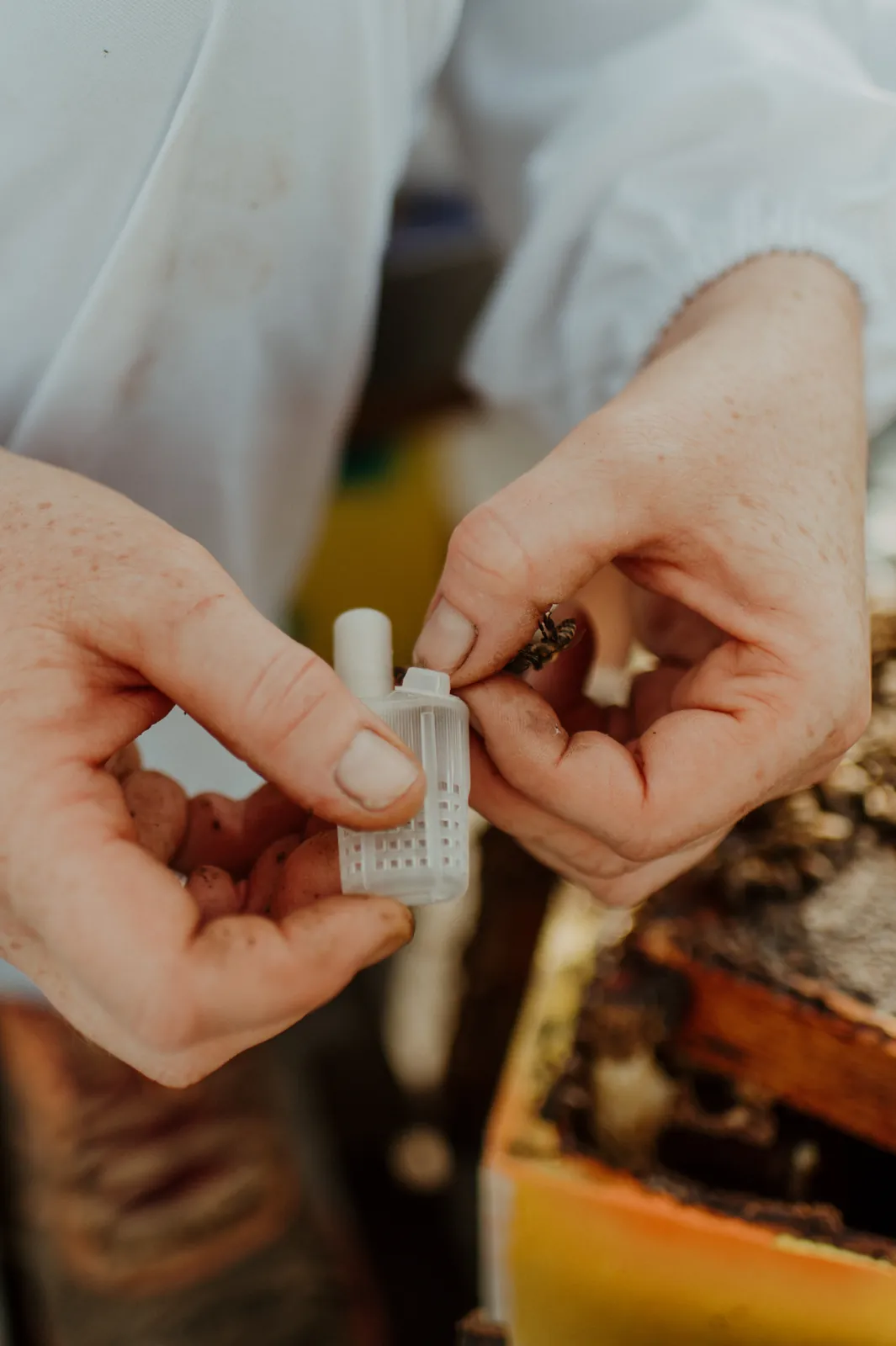
We ship queens across Canada every week from early May to August. Each queen travels in a plastic cage with attendant bees, candy, and protein. Each shipping box has air vents made of hardware cloth mesh, so the queens have airflow the whole way.
Shipping is $50 flat on orders of fewer than 5 queens, anywhere in Canada. Packing and posting a small order takes the same work as a large one, so it carries the same rate. The season runs from the beginning of May to about the tenth of August.
We will ship you a single queen. Not many breeders in Canada will. One queenless hive is reason enough to order.
We ship within Canada only. Queens can come into the country from the United States but they cannot go the other way.
You can also collect queens at the farm rather than post them. Tell us which you would rather do when you order.
Mated queen $60
Mated, laying, and marked. Any quantity, from one up. Shipped weekly early May to August, or picked up at the farm. $60 each for 1 to 10, $56 each for 11 to 100, and $48 each over 100.
Queen cell $15
A capped cell, for beekeepers who would rather let her emerge and mate in their own yard. Ask for numbers and timing.
Breeder queen
Breeding stock for beekeepers raising their own queens. Quoted on ask, by the season's grafting schedule.
Draft figures, set from market rates. Not confirmed.
Order terms
- Shipping season
- Early May to late August
- Order cutoff
- Friday noon for the following week
Temperament
Bred to be workable
Temperament is one of the traits we select for. We do not breed from a colony that boils over every time the lid comes off. Our rule is not overly aggressive. We do take a few stings.
Plenty of our queens head hives in backyards and subdivisions where the neighbours are close. If that is where your hive sits, say so when you order. We will tell you what to expect.
Wintering
Raised for a Canadian winter
Our queens are raised and overwintered here in the B.C. interior. A large share of the queens sold in Canada each spring are flown in from Hawaii, California, Australia, New Zealand, or Chile. Those queens are excellent at making bees. They build a huge colony, which is great for a honey crop. But they come from places where winter is mild, so they have never had to conserve resources. Local queens know how.
To be fair to the beekeepers who import, Canada does not have enough queen breeders. There is not enough local supply.
Every breeder queen we graft from has come through at least two winters here first. Beekeepers run this stock in the Kootenays, the Cariboo, and east to Manitoba, on sites colder and higher than ours. If your winter is longer than ours, ask about an early nucleus colony. The early ones are headed by an overwintered queen.
What else we sell
Marked queens, cells, and breeder stock
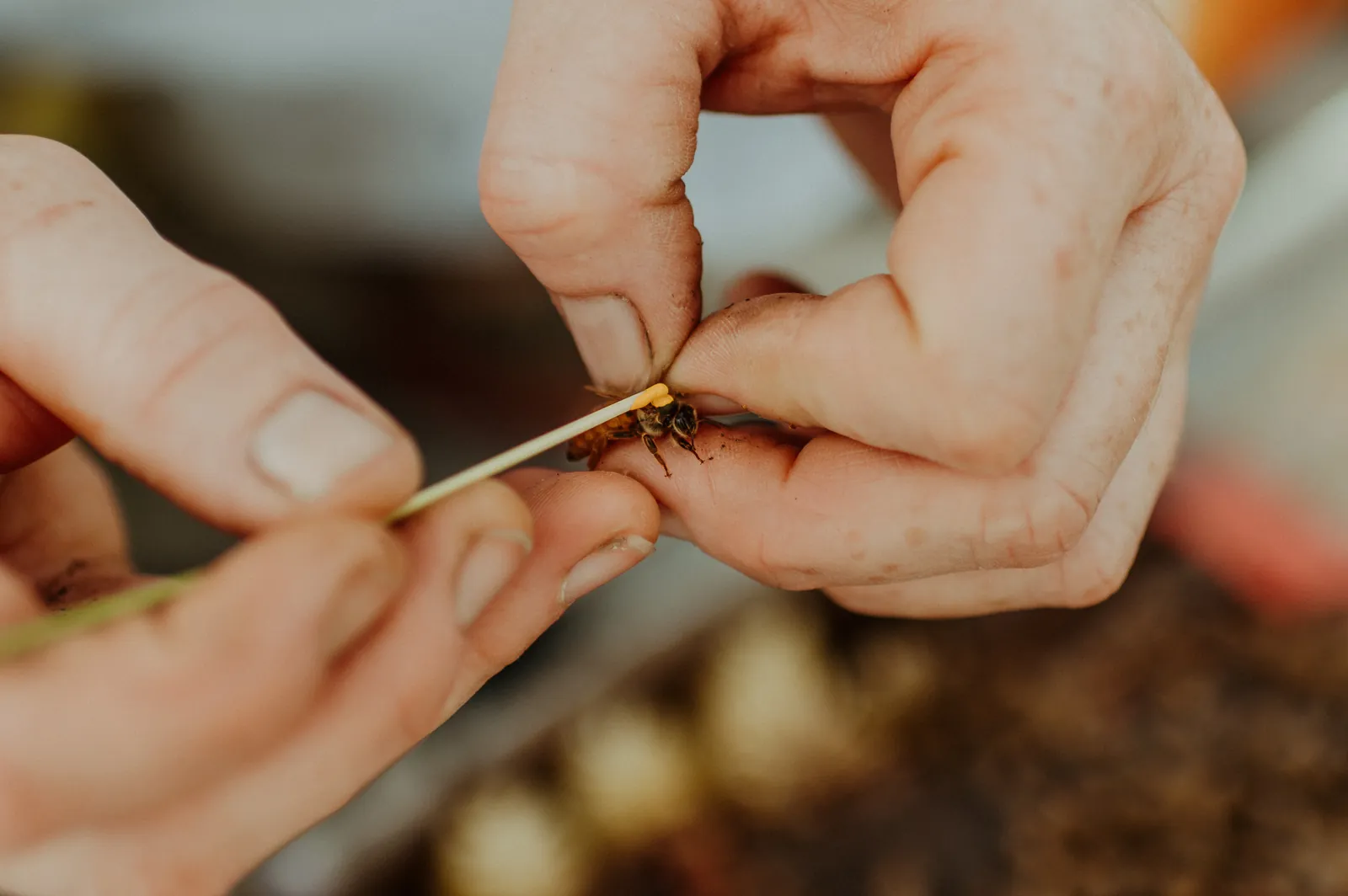
Every mated queen leaves here marked, so you can find her on the frame without hunting through the box.
We also sell queen cells, for beekeepers who would rather let her emerge and mate in their own yard, and breeder queens, for beekeepers raising their own. Numbers and timing follow the grafting schedule, so tell us what you need and when. Ask early.
Testing
We test what we breed
We catch each queen after she has started to lay, so we see her laying pattern before she goes in a cage. We are trying not to sell dud queens.
We screen our breeder colonies for hygienic behaviour and varroa sensitive hygiene, the traits that let a colony find and clear out infested brood. Every year we send queens to the National Bee Diagnostic Centre in Beaverlodge, Alberta. They check sperm count and sperm viability, weight and size, and screen for a range of viruses and other infections. We want to know our queens hold up against the imports from California and Hawaii.
Our bees are provincially inspected by the BC Ministry of Agriculture. Inspection reports go to every buyer of live bees.
Research
Working with universities
We are still learning, and that is what we love about beekeeping. So we work with researchers. Our closest collaborator is Dr. Alison McAfee of the Foster Lab at UBC's Michael Smith Laboratories, who studies queen health and fertility.
- Common viral infections inhibit egg laying in honey bee queens, Scientific Reports, 2024. Every queen in the study came from Wild Antho.
- Honey bee egg composition changes seasonally and after acute maternal virus infection, Scientific Reports, 2025.
- Trade-offs between sperm viability and immune protein expression in honey bee queens, Communications Biology, 2021.
- Vulnerability of honey bee queens to heat-induced loss of fertility, Nature Sustainability, 2020.
Our hives were also part of the Canadian Bee Gut Project at the University of Guelph, which has now finished. We are still working with Guelph on queen cell research. The project's lead, Dr. Brendan Daisley, published a national study of winter losses in 2025. Read our summary of it.
Find us in the Queen Alliance directory of Canadian queen breeders, under B.C. and Yukon.
Listen
Hear it from Emily
Emily talked through our queen breeding on the Farming in British Columbia podcast: The Queen Bee (Breeder) of Spallumcheen. For honey and the business of bees, start with Wild Antho: Beekeeping in Armstrong.
Ten or more
Buying in quantity
Commercial outfits, clubs buying together, and research programs have their own page, with how a large order gets filled and what to send us. Supply shops that want to resell our queens, see become a stockist.
Buying one, on the coast? Urban Bee Supplies in Delta carries our queens through the season, and it is a great place for bee equipment too. See where to buy.
Want the bees too
Every nucleus colony is headed by a queen we reared
If you want a colony and not only a queen, our nucleus colonies are packed with bees and headed by a queen we reared.
When to order
The ordering year
Queens ship from the first week of May to about the tenth of August. Everything before that is booking, and the earliest bookers get the weeks they want.
- October to January
- Orders open for the coming spring, and the waiting list forms. Standing orders from repeat buyers carry over first. This is the quiet, sensible time to book.
- February to April
- The busiest months. Most of the nucleus colonies and a good share of the queens are spoken for in this window, so a February order gets what a May order cannot.
- Mid April to May
- Nucleus colonies are collected at the farm. The first 4 frame nucleus colonies are ready from mid April, headed by an overwintered queen. Queens start shipping in the first week of May and go out weekly from then on.
- June
- The last nucleus colonies go out, and a June nucleus colony is a bonus rather than the plan. Queens keep shipping every week.
- July to August 10
- Queens only. Late July into early August is the last good window to requeen before a colony starts raising its winter bees. Shipping stops around the tenth.
- August to September
- Honey. The crop comes off, three varieties are usually on hand, and the farm shop is the place to get it.
Read more
Three questions we get asked
What a queen bee costs in Canada, and what the price does and does not include.
How we breed varroa resistant bees, what the mite does, and why breeding beats a treatment treadmill.
How long a queen bee lives, how to spot her on the comb, and when to replace her.
Questions
Common questions
When are Wild Antho queens available?
Wild Antho ships mated queens every week from early May to about the tenth of August. Queens are not available outside that season, and late July into August is the last good window to requeen before a colony starts raising winter bees.
How much is a mated queen?
A mated Wild Antho queen is $60 each for 1 to 10, $56 each for 11 to 100, and $48 each over 100. Orders of fewer than five queens pay a flat $50 to ship, because a small order costs the same to pack and post as a large one.
Will you sell just one queen?
Yes. Wild Antho will ship a single queen, which most Canadian queen breeders will not do. There is no minimum order, so one hive that went queenless in June is reason enough to order.
Where do you ship queens?
Wild Antho ships queens anywhere in Canada by Canada Post and courier. Queens cannot be shipped to the United States: they are allowed to cross the border going north into Canada, but not going south.
What stock are the queens from?
Wild Antho queens come from a British Columbia line bred on the farm at Armstrong, and the line runs back to Liz Huxter's honey farm at Grand Forks. Emily Huxter is at least the fourth generation of her family to keep bees, back to a dairy farm in England that kept hives alongside the herd. The queens are raised and overwintered in the B.C. interior rather than imported from a warmer country.
Are the queens tested for mite resistance?
Wild Antho screens its breeder colonies for hygienic behaviour and varroa sensitive hygiene, and sends queens for queen quality testing at the National Bee Diagnostic Centre every year. Every buyer of live bees also gets the B.C. Ministry of Agriculture inspection report.
Can I pick queens up at the farm?
Yes. Wild Antho queens can be collected at the farm on Round Prairie Road north of Armstrong, B.C., or posted anywhere in Canada. Say which you want when you order.
Do the queens come marked?
Yes. Every mated queen leaves Wild Antho marked, so you can find her on the frame without hunting through the box.
Do you sell queen cells or breeder queens?
Yes to both. Wild Antho sells capped queen cells, at $15 a cell, to beekeepers who would rather let a queen emerge and mate in their own yard, and breeder queens to beekeepers raising their own. Numbers and timing follow the grafting schedule, so ask early.
How gentle are the bees?
Temperament is one of the traits Wild Antho selects for, and a colony that boils over at every inspection is not one they breed from. Plenty of these queens head hives in backyards and subdivisions, so say where the hive sits when you order.
Will these bees survive a colder winter than Armstrong?
Wild Antho queens are raised and overwintered in the British Columbia interior, not imported from a country where winter is mild, and every breeder queen has come through at least two winters before she is grafted from. Buyers run this stock through the Kootenays, the Cariboo, and east to Manitoba.
Do you have queens available right now?
The availability line at the top of the Wild Antho queen bees page is kept current and dated, so it is the fastest answer. Queens ship weekly from early May to about August 10, and orders for the coming season open the previous October.
Do you sell overwintered queens?
Ask. Wild Antho overwinters queens at Armstrong and there are usually a small number available in spring, ahead of the first grafts. The early nucleus colonies are headed by an overwintered queen as well.
Can I get a queen late in the season?
Wild Antho ships queens to about the tenth of August and stops after that, because a queen introduced later has little time to prove herself before the cold. Ask in September or October about a banked queen: some years there are spares held in bank colonies, some years there are none.
What comes with a queen?
A Wild Antho queen ships mated and laying, in a cage with attendant bees and candy. Introducing her to the colony is the buyer's job: leave her caged, let the bees eat through the candy over a few days, and do not open the hive for a week.